
There's a particular kind of frustration that comes from wanting to feel something and finding that your body has already clocked off for the day. The mind is willing - or at least trying to be - but the physical response feels muted, like trying to light a candle in a wind tunnel. We often interpret this as a sign to give up entirely, when in reality it's more of a cue to recalibrate.
The good news is that stress and exhaustion don't make pleasure impossible. They just mean the conditions are different, and approaching sex the same way you would on a relaxed, well-rested afternoon isn't going to work. Understanding why the body behaves differently under load is the first step to meeting it where it actually is.
Two different problems
It's worth separating stress and exhaustion, because they're not actually the same physiological state. Polyvagal theory, developed by neuroscientist Stephen Porges, maps the nervous system into three broad conditions. The first is a ventral vagal state - the baseline of feeling safe, connected and present, which is the only one of the three where genuine intimacy is really possible. The second is sympathetic activation: the mobilised, high-alert state that stress produces. The third is something closer to a shutdown or dorsal vagal state, which is where deep exhaustion often lands; a kind of physiological withdrawal where the system has simply decided it has nothing left to give.
Stress and exhaustion might feel similar on the surface, but they often need slightly different approaches. A stressed nervous system needs to be calmed down and made to feel safe. An exhausted one sometimes just needs the bar lowered enough that the body can stay engaged without feeling like it's being asked to perform.
The brakes and the accelerator
One of the most useful frameworks for understanding why stress affects desire comes from the Dual Control Model, developed at the Kinsey Institute and popularised by researcher Emily Nagoski. The model proposes that our sexual response system has two components running simultaneously: a Sexual Excitation System - the accelerator - which responds to things that are sexually relevant, and a Sexual Inhibition System - the brakes - which responds to anything the nervous system reads as a potential threat.
The important distinction here is that stress doesn't just reduce the accelerator. It actively pushes on the brakes. The result is that even if something is genuinely pleasurable or desirable, the inhibitory signal can be strong enough to override it. This is why trying harder, going faster or adding more intensity when you're already stressed usually backfires - it's not that the accelerator isn't being pressed, it's that someone has a foot on the brake that needs to come off first.
For most people, common brake activators include stress, anxiety, self-consciousness, a sense of obligation and feeling physically uncomfortable. Removing those conditions, even partially, does more to restore arousal than almost anything else.
You don't have to feel it first
One of the most persistent myths about desire is that it has to arrive before anything else can happen. Gynaecologist Rosemary Basson's research into sexual response - later expanded on by Nagoski - challenged the traditional linear model and proposed something closer to a circular one. In Basson's model, many people, particularly when in long-term relationships or under ongoing stress, experience what's known as responsive desire: arousal that emerges in response to stimulation and context, rather than appearing spontaneously beforehand.
This matters a great deal for stressed or tired sex, because it means not feeling like it at the outset isn't necessarily a dead end. It's a starting condition, not a verdict. The body's interest can follow if it's given low-pressure, low-stakes conditions to warm up in but only if we're not already monitoring ourselves for signs of failure while it's happening.
Lowering the activation bar
The instinct when arousal feels distant is to try harder; more intensity, more stimulation, faster. When the inhibitory system is already active, this almost always makes things worse. The more effective move is to begin slower and lower than you normally would, with the explicit understanding that the first phase isn't about building toward anything. It's just about giving the nervous system a reason to downshift.
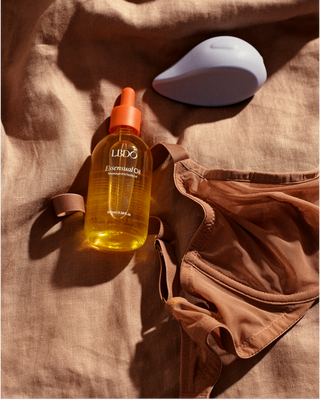
If you usually reach for Rush at a high setting, starting on the lowest becomes less about managing sensitivity and more about meeting the brakes where they are. When natural lubrication is slower to arrive which cortisol reliably causes, by diverting blood flow away from the pelvic tissues; a lubricant like Flow Water-Based removes friction before it becomes a distraction, keeping the nerve endings available for pleasure signals rather than discomfort ones. Getting rid of that physical barrier is a quiet but effective way of reducing inhibitory input.
What the brain is actually doing
Researcher Lori Brotto at the University of British Columbia has spent years studying something called arousal non-concordance; the gap between what the body is physically doing and what the mind is actually registering as pleasurable. Her clinical research found that when attention is elsewhere, the brain essentially discards incoming sensory signals before they can be processed as pleasurable, even when the body is technically responding.
This is why stressed sex so often feels like going through the motions even when there's nothing mechanically wrong. The mind is busy elsewhere, and pleasure requires the brain's active participation to land. What Brotto's work consistently found was that directed attention - specifically a non-judgemental focus on present physical sensation - significantly improves the depth of the experience. Not forced presence, not positive thinking, just narrowing the focus to something specific and physical: the sensation of warmth, the rhythm of breathing, the texture of touch. Giving the mind a small enough anchor that it can actually stay with it is one of the most effective tools available, and it costs nothing.
Redefining what good sex looks like on these days
Stressed or exhausted sex is rarely going to replicate the experience of a relaxed, unhurried afternoon. Holding it to the same standard is a setup for disappointment. What it can be is genuinely restorative, not in a performative wellness way, but because even a modest release of oxytocin and dopamine is doing something useful for a system that's been running too hot.
The most effective shift is reframing the goal entirely. Instead of trying to replicate a peak experience, the aim becomes release - of tension, of the day, of the low-level vigilance the body has been carrying around. When the brakes have been on all day, the most generous thing you can do is stop pressing the accelerator and start addressing the inhibition instead: reduce the demands, lower the stakes, make the conditions feel a little safer. Desire, in many cases, will follow.
On difficult days, the body isn't asking to be pushed. It's asking to be given a reason to let go.